

July 27 – 1 August 2026
Joculatores Domini
From the Laudes Creaturarum of St. Francis to the polyphonic lauda repertoire of the 15th century
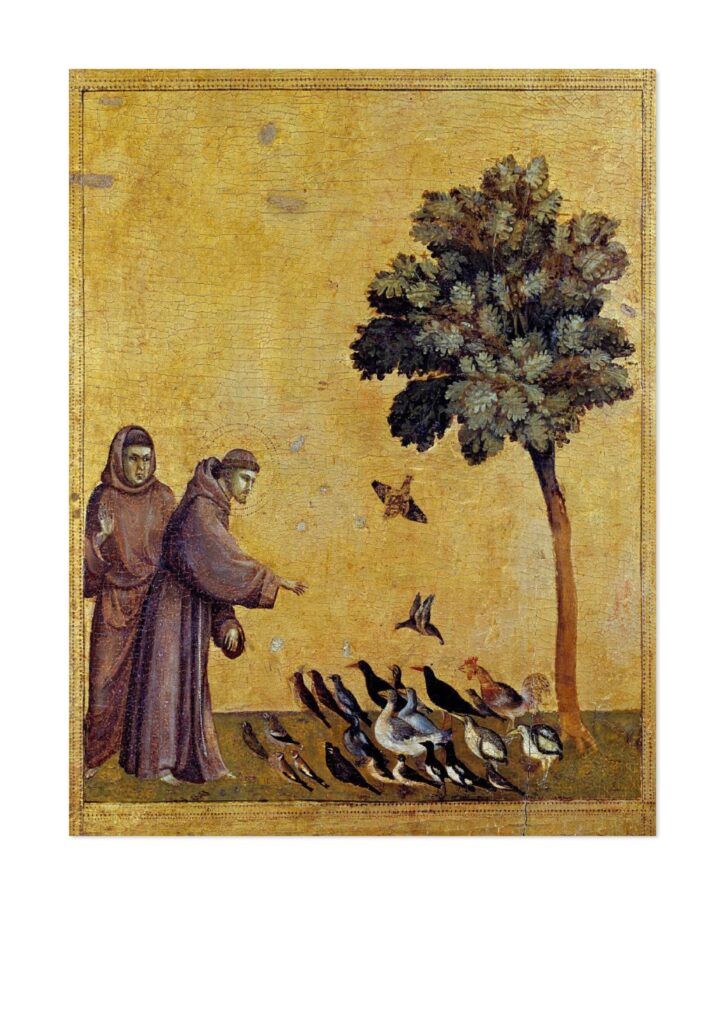
From the Laudes Creaturarum of St. Francis to the lauda repertoire of the 15th century
The ‘Canticle of Creatures’, the first lauda and poetic text written in the Umbrian vernacular in 1225, is the cornerstone of the 16th International Medieval Music Course 800 years later. The poem, embodies Francis’ love for creation and all animate and inanimate things. Probably inspired by the Canticle of the Three Little Children, it was meant to be sung, and as the anonymous author of the Assisi Compilation conveys to us, it was Francis himself who composed a melody that he taught to his companions:
“…I want therefore, to praise him and to my consolation and for the edification of my neighbor, to compose a new laud of the Lord concerning his creatures. Every day we use creatures and without them we cannot live […]. And seating himself, he concentrated on pondering and then said, Most High, Almighty, good Signor. And he composed therein a melody and taught it to his companions for them to repeat.” (Assisi Compilation, ch. 83).
It was with the Franciscan movement during the lifetime of Francis of Assisi (1182-1226) that the first experiments in religious poetry in the vernacular were made.
The text of the Canticle of Creatures is preserved in Codex 338 of the Biblioteca Comunale di Assisi, but the space under the incipit, intended for music notation, remained blank. Following the research of Lucia Marchi and other scholars, a musical reconstruction for this text can be attempted by relying on the Gregorian repertoire contemporary with Francis’ life, that he surely knew and from which he may have drawn inspiration.
Francis and his brothers called themselves joculatores domini “minstrels of God”; they were mendicants of the Franciscan order whose rule was to preach and help the poor. Singing praises in public squares and gathering many followers, they created a fervent movement that spread very quickly in Italy and far beyond.
Among the many books of laudi, preserved generally without music, we have the exception of the Cortona Codex 91 (late 13th cent.) and the Laudario Magliabechiano B.R. 18 (mid-14th cent.), in which there are the oldest and most valuable musical records of a vast tradition. This tradition was initially entrusted only to the memory of the performers, custodians of a very rich repertoire of which, unfortunately, only the part transmitted by the codices remains.
The course will therefore start by examining the manuscripts that have transmitted early monodic repertoire: Ms. Cortona 91 and Magliabechiano B.R.18, preserved in Florence. These sources were created in order to help codify the confraternal rituals that had the daily practice of singing lauds as the basis of their statutes. Polyphonic laude of the 14th and 15th centuries from the Florentine and Veneto areas will also be studied.
We know, from recent research, that dance could accompany the singing of some lauds, sacred dance was part of that gladness that was supposed to accompany the praises of God this always according to Francis’ thought. A course on traditional sacred dances of the Mediterranean area lead by Placida Staro will try to reconstruct part of the practice of sacred dances.
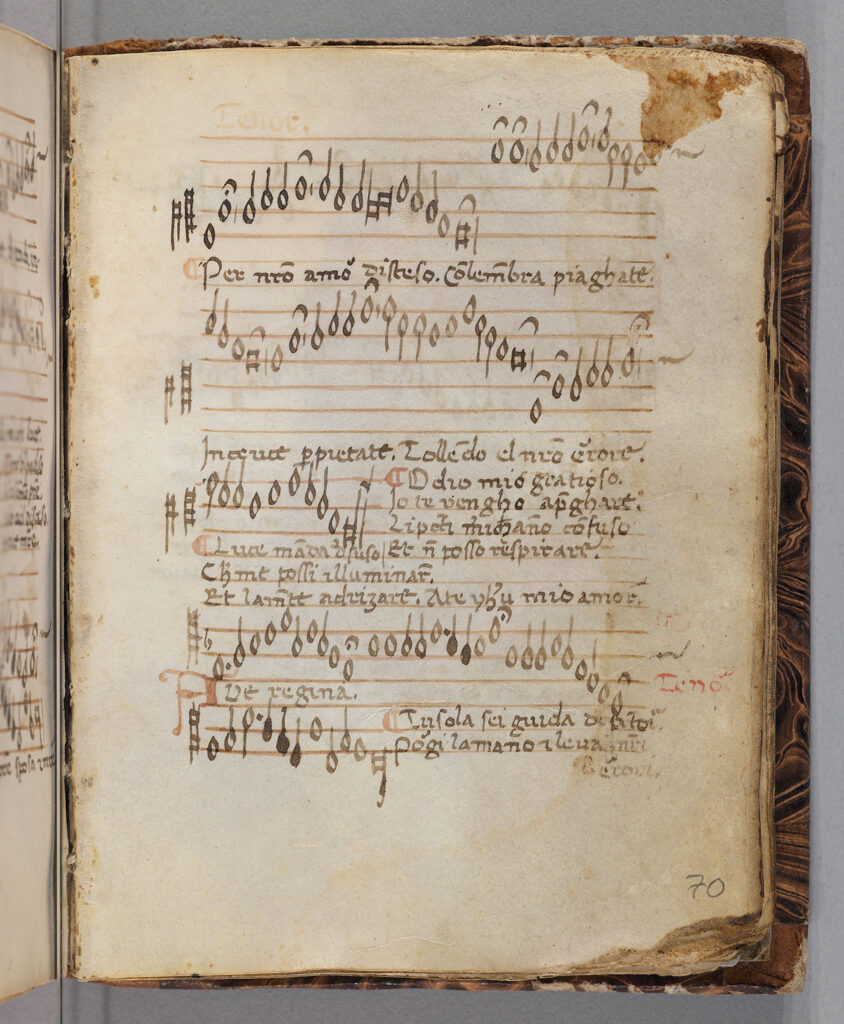
Others Laudi comes from the Franciscan tradition of manuscript West. 84. The music is from Marche region of central Italy and the neighboring regions of Umbria and Abruzzo. The songs are largely unknown and originate from a single late-fifteenth-century manuscript, West. 84, held at Columbia University, New York.
It is a new research of musicologist Francesco Zimei on two voice polyphonies in the style of archaic discants, characterized by a melody or counterpoint sung above a tenor. The texts are in the vernacular and bring to life local dialects in a new solo performance style rather than the more common choral form.
Prof. Zimei highlights the function of some of these laude (nonliturgical devotional songs or praises) in I “cantici” del Perdono (LIM 2015), a few of which are dedicated to the Virgin of Loreto, and the request for protection from the terrible plagues of the 15th century.
MASTERCLASS
(higher technical level):
Crawford Young :
Andres Montilla Acurero : Gregorian chant “The liturgy of Francis”
Reconstruct through historical sources what could have been the Gregorian liturgy sung by the brothers of Francis of Assisi
Ordinary Courses
(for everyone), in which it is possible to study, in addition to the selected music, even the repertoire of your choice.
Ordinary Courses
Singing: Patrizia Bovi – assistant Andres Montilla
Gregorian chant: Andres Montilla
Wind instruments (pipe & tabor, flutes, bagpipes): Goffredo Degli Esposti
Fiddle/ Rebec: Gabriele Russo
Hurdy-gurdy / Symphonia: Giordano Ceccotti
Alta Cappella / Shawn: Ian Harrison
Lute, guittern and oud (Europe – Middle East): Peppe Frana
Percussion / Dulcimer: Enea Sorini
Traditional sacred dances*: Placida Staro (July 29th – 1st August )
LESSONS are INDIVIDUAL, and concern both technique and interpretation within historical performance practice. Lessons are open to auditors*
Traditional dances teaching will be given as GROUP LESSONS
WORKSHOPS FOR ENSEMBLES
ENSEMBLE FOR WINDS AND PERCUSSIONS A – Ian Harrison / Enea Sorini
ENSEMBLE CLASS FOR SMALL GROUPS (beginners) A – 1° Goffredo Degli Esposti / 2° Gabriele Russo
ENSEMBLE CLASS FOR SMALL GROUPS (advanced) A – Peppe Frana
TRADITIONAL DANCES B – Placida Staro
DAILY SCHEDULE
9.30 a.m.-1.00 p.m. LESSONS and TRADITIONAL DANCES
1:00-3:00 p.m.: LUNCH BREAK
3:00-4:45 p.m.: WORKSHOPS A and MASTERCLASS
- ENSEMBLE CLASS FOR SMALL GROUPS (beginners)
- ENSEMBLE FOR WINDS AND PERCUSSIONS
5:15-7:00 p.m.: WORKSHOPS B and MASTERCLASS
- ENSEMBLE CLASS FOR SMALL GROUPS (advanced)
- TRADITIONAL DANCES
EVENING – (program in preparation)
SUNDAY 26 of July
registration and payment
6:30-7:30 p.m.: Welcome aperitif
August 1st: FINAL CONCERT by the students
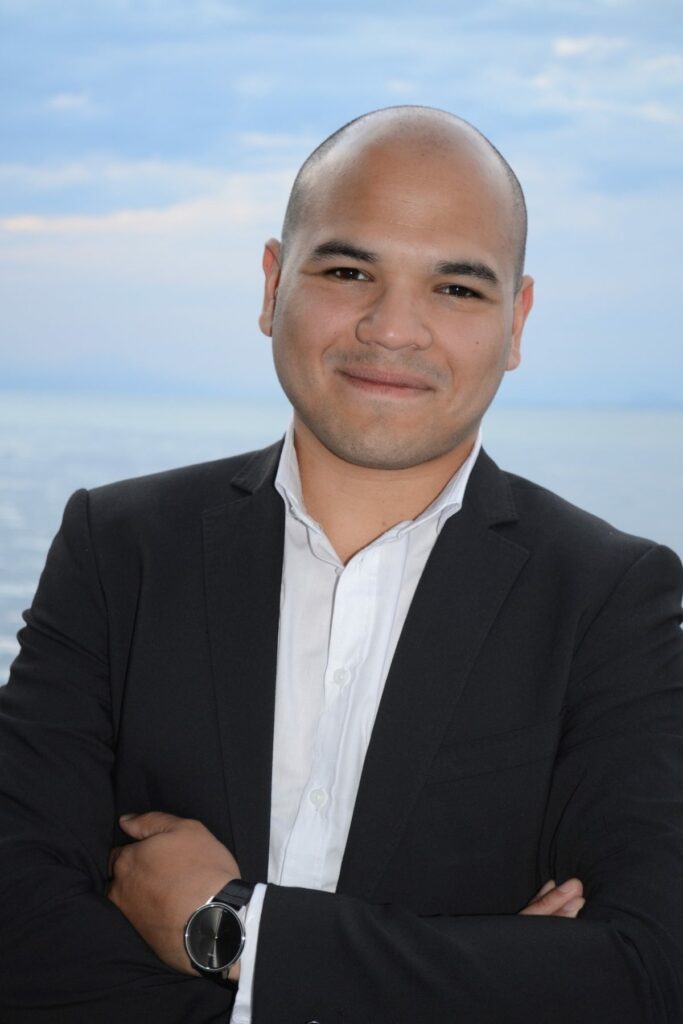
Andres Montilla Acurero : Gregorian chant “The liturgy of Francis”
Andrés Montilla-Acurero
Born in Venezuela, he completes studies in Singing with Alessandro Quarta, specializing in Baroque Singing with Gemma Bertagnolli and Teresa Chirico (Conservatorio L. Refice), in Gregorian Chant and Semiology with Alberto Turco and in Vocal Chamber Music and Vocal Ensemble Conducting with Anthony Rooley and Evelyn Tubb (Schola Cantorum Basiliensis).
He regularly collaborates as tenor/haute-contre with conductors such as Jordi Savall, Rinaldo Alessandrini, Alessandro Quarta, Ketil Haugsand, Francesco Cera, Patrizia Bovi, Jörg-Andreas Bötticher, Claudio Astronio, Fabio Lombardo, Walter Testolin, Michele Vannelli and Stephen Smith, and with ensembles such as Concerto Romano, Concerto Italiano, La Capella Reial de Catalunya, Ensemble Arte Musica, Micrologus, La Venexiana, Theresia Baroque Orchestra, De Labyrintho, Odhecaton, Concerto Ibérico, L’Homme armé, Voces Suaves, and La Compagnia del Madrigale.
His repertoire focuses on the tenor-alto parts of 17th-century Italian, haute-contre parts of 17th-7th-century French, and 18th-century tenor parts, with special emphasis on the role of the Evangelist in Bach.
Recently he has performed the role-title of Lully’s Persée at the Amuz Flanders Festival in Antwerp, the Musikhuset Aalborg Opera Festival and the Copenhagen Renaissance Music Festival, the role-title of Rameau’s Zoroastre conducted by C. Astronio at the Sagra Musicale Malatestiana in Rimini within a film production directed by Gianni Di Capua, the role-title of Stradella’s Oratorio San Giovanni Battista conducted by A. Quarta, the role of Arnalta in Monteverdi’s L’Incoronazione di Poppea in Bologna directed by M. Vannelli with direction by A. Allegrezza, the role of Shepherd in Monteverdi’s L’Orfeo in Barcelona, Adelaide and Beijing directed by R. Alessandrini, the role of Eumete in Monteverdi’s Il Ritorno d’Ulisse in Patria directed by A. Quarta at the Teatro di Villa Torlonia and Teatro Flavio Vespasiano in Rieti, the role of Un Athlète in Rameau’s Castor et Pollux in Heidelberg, and the role of Nutrice in L’Incoronazione di Poppea at Theater Kiel directed by A. Quarta. She will soon play the role of Architecture in Fux’s Gli ossequi della notte in Graz, directed by A. Bernardini.
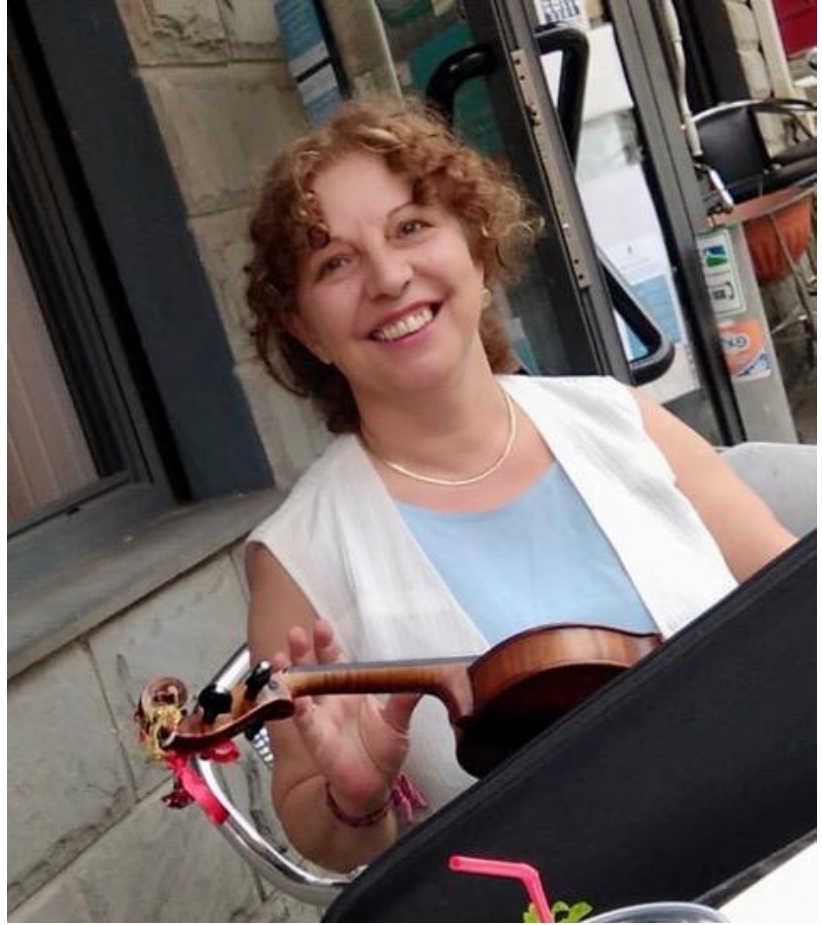
Traditional sacred dances of the Mediterranean countrie
Placida Staro, known as ‘Dina’ has been working on the relationship between sound, voice, gesture and culture, on the self-research of local cultures and on symbolic and choreutic-musical expression since she was a little girl. Through field research in ethnography, documentation in archives in Italy and abroad, methodological and epistemological research on the analysis of movement and the techniques of bodily processing of self-discovery in song, music and dance, she has developed original terminologies and epistemological approaches and new methodologies in the field of training and education that are internationally recognised. Her artistic activity as a stage director, choreographer, violinist, actress and singer, which began in 1974, is still ongoing. She is currently President of the Ethnochoreology Study Group of the International Council for Traditions of Music and Dance, Director of the Centre for Research and Documentation of Montanara Culture in Monghidoro, directs two publishing series and in 2023 received the ‘Loano Award for Traditional Music’ for her career.
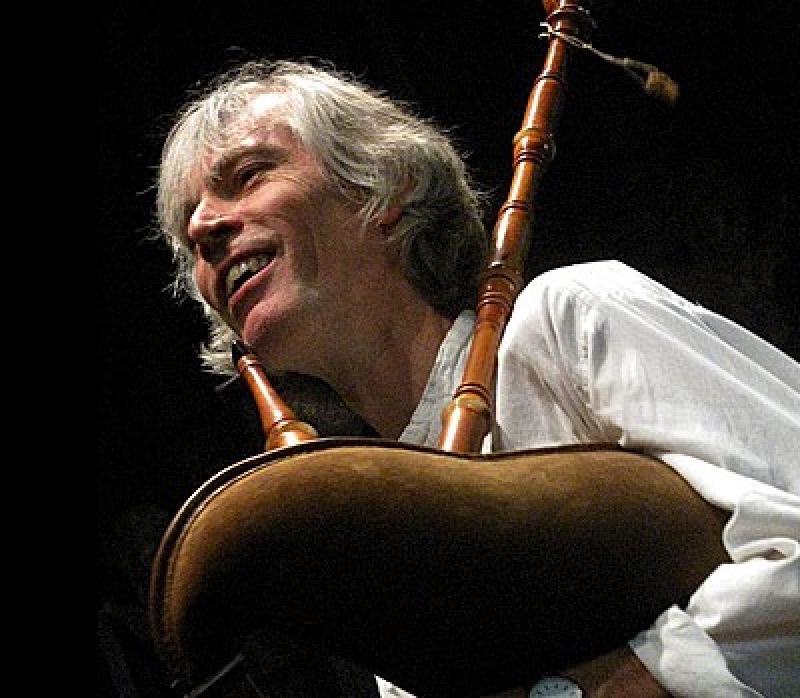
IAN HARRISON Alta Cappella course
Ian Harrison grew up in Newcastle upon Tyne, the last corner of England with a traditional bagpipe. He began his musical carreer as a Lay Clerk in the choir of Canterbury Cathedral. He gained a MA in Music Performance Practice at the City University, London and went on to study at the Royal Conservatory, The Hague and at the Schola Cantorum Basiliensis in Basel. As co-director of the medieval and Renaissance ensemble Les haulz et les bas, and of The Early Folk Band, as well as a guest in ensembles such as Sequentia, The Harp Consort, Hirundo Maris, the Metropole Orchestra, Hilversum and the Freiburger Barockorchester, he has played and broadcast throughout Europe, America, Asia and Ausralia, and has taken part in numerous highly-acclaimed CD productions. He specializes in historical wind instruments, noteably the shawm, cornett, flageolet and historical bagpipes. The international press has hailed him ‘brilliant’, ‘ecstatic’, and ‘the Miles Davis of Early Music’. His original, virtuosic and improvisational skills have earned him prizes at the Bruges Early Music Festival, the Rencontres des Maitres Sonneurs, St. Chartier and the German Pop and Rock Awards, among others. He teaches shawm and ensemble music at the Schola Cantorum Basiliensis, and historical improvisation at the Hochschule für Musik und Darstellende Kunst, Frankfurt, as well as being in demand as a teacher and lecturer at workshops and conferences.
CONFERENCES
(FREE)
(work in progress)
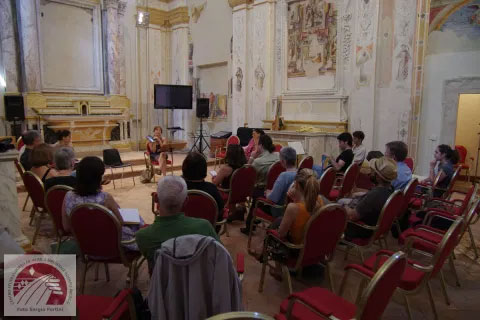
FEES
STUDENT FEE*:
Singing/Instrument/Masterclass: 350 €
TRADITIONAL SACRED DANCES : 80€
*Fee includes LESSONS and WORKSHOPS
2° COURSE FREQUENCY:
Singing/Instrument/Masterclass: 280 €
TRADITIONAL DANCES : 70€
WORKSHOPS ONLY:
Singing/Instrument: 200 €
TRADITIONAL SACRED DANCES : 80€
ENSEMBLE FEE* (minimum 3 members):
Singing/Instrument/Masterclass: 290€
TRADITIONAL DANCES (minimum 6 members): 190€
*Fee includes LESSONS and WORKSHOPS
2° COURSE FREQUENCY FOR ENSEMBLE:
Singing/Instrument course: 250 €
WORKSHOPS ONLY FOR ENSEMBLE (minimum 3 members):
Singing/Instrument: 190 €
TRADITIONAL DANCES (minimum 6 members): 60€
DEADLINE: extended to 10 June
We kindly ask the students to send an advance of €. 100 from 1st to 10th July to finalize the application.
After this date will be still possible to apply with an additional fee of 40€.
It is possible to have 6 LUNCHES by paying €. 100 more (20 € single lunch), menu Bio.
Here is the APPLICATION FORM 2026 to fill out and, please, send a email to stefania.segreteria@centrostudiadolfobroegg.it
APPLICATION FORM
Name:
Surname:
Date and place of birth:
Address:
City:
Postal code:
Phone:
Mobile:
e-mail:
Applications to the Course:
Level: beginner advanced
Instrument played and preferred tuning:
Practical vocal or instrumental since:
at:
Knowledge of voice / instrument (specify diploma conservatory, regular school attendance courses, private education, autodidact):
Teachers had:
Other musical knowledge:
It allows the processing of personal data in accordance with standards Decree No. 196/2003.
Date:
Signature:
Please send the application form at: stefania.segreteria@centrostudiadolfobroegg.it