17th International Course of Medieval Music

July 27 - 1 August 2026

Joculatores Domini

From the Laudes Creaturarum of St. Francis to the polyphonic lauda repertoire of the 15th century

From the Laudes Creaturarum of St. Francis to the lauda repertoire of the 15th century

The ‘Canticle of Creatures’, the first lauda and poetic text written in the Umbrian vernacular in 1225, is the cornerstone of the 16th International Medieval Music Course 800 years later. The poem, embodies Francis’ love for creation and all animate and inanimate things. Probably inspired by the Canticle of the Three Little Children, it was meant to be sung, and as the anonymous author of the Assisi Compilation conveys to us, it was Francis himself who composed a melody that he taught to his companions:

“…I want therefore, to praise him and to my consolation and for the edification of my neighbor, to compose a new laud of the Lord concerning his creatures. Every day we use creatures and without them we cannot live […]. And seating himself, he concentrated on pondering and then said, Most High, Almighty, good Signor. And he composed therein a melody and taught it to his companions for them to repeat.” (Assisi Compilation, ch. 83).

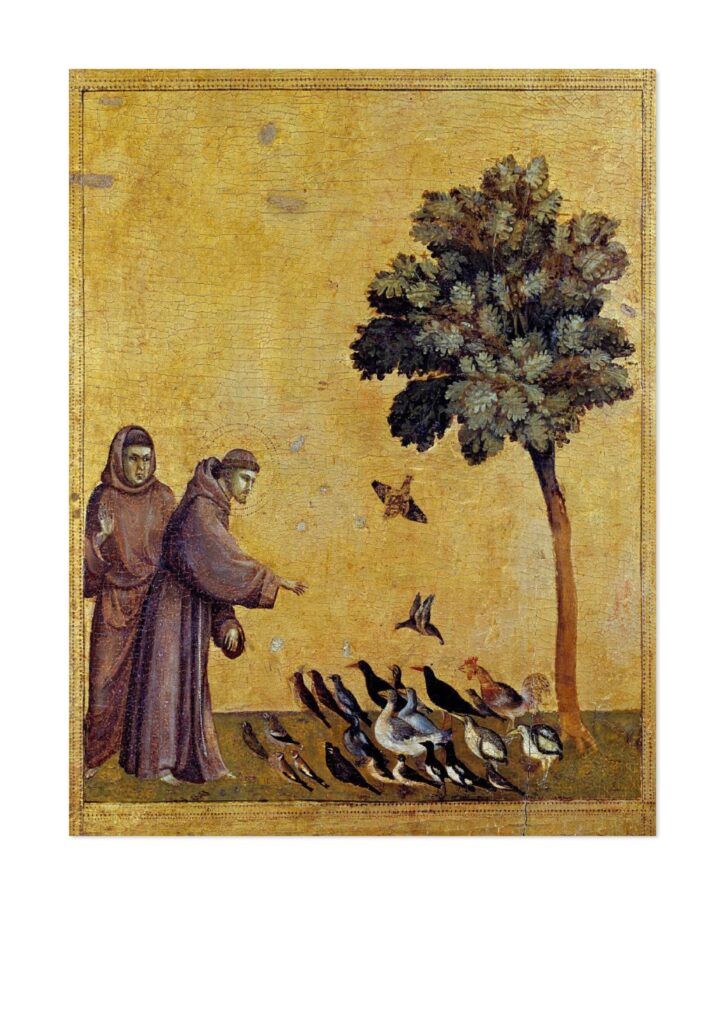
It was with the Franciscan movement during the lifetime of Francis of Assisi (1182-1226) that the first experiments in religious poetry in the vernacular were made.

The text of the Canticle of Creatures is preserved in Codex 338 of the Biblioteca Comunale di Assisi, but the space under the incipit, intended for music notation, remained blank. Following the research of Lucia Marchi and other scholars, a musical reconstruction for this text can be attempted by relying on the Gregorian repertoire contemporary with Francis’ life, that he surely knew and from which he may have drawn inspiration.

Francis and his brothers called themselves joculatores domini “minstrels of God”; they were mendicants of the Franciscan order whose rule was to preach and help the poor. Singing praises in public squares and gathering many followers, they created a fervent movement that spread very quickly in Italy and far beyond.

Among the many books of laudi, preserved generally without music, we have the exception of the Cortona Codex 91 (late 13th cent.) and the Laudario Magliabechiano B.R. 18 (mid-14th cent.), in which there are the oldest and most valuable musical records of a vast tradition. This tradition was initially entrusted only to the memory of the performers, custodians of a very rich repertoire of which, unfortunately, only the part transmitted by the codices remains.

The course will therefore start by examining the manuscripts that have transmitted early monodic repertoire: Ms. Cortona 91 and Magliabechiano B.R.18, preserved in Florence. These sources were created in order to help codify the confraternal rituals that had the daily practice of singing lauds as the basis of their statutes. Polyphonic laude of the 14th and 15th centuries from the Florentine and Veneto areas will also be studied.

We know, from recent research, that dance could accompany the singing of some lauds, sacred dance was part of that gladness that was supposed to accompany the praises of God this always according to Francis’ thought. A course on traditional sacred dances of the Mediterranean area lead by Placida Staro will try to reconstruct part of the practice of sacred dances.

Corpus of songs from the West manuscript. 84, late 15th century (Columbia University, New York) This collection concerns the Franciscan tradition of the Marche and neighboring regions of Central Italy (Umbria and Abruzzo), largely unknown and originating from a single late 15th-century manuscript now preserved at Columbia University (New York). These are two-part polyphonies, similar to archaic descants, with vernacular texts and local dialect influences, or with the accompaniment of various musical instruments used in the confraternities and oratories of the time. Some of these lauds are dedicated to the Virgin of Loreto, with a request for protection from the terrible plagues that occurred in the 15th century. Other songs deal with Christmas and the Passion of Christ.

The Course is divided into two levels:

Masterclass

(higher technical level):

Crawford Young :   

Andres Montilla Acurero :  

Ordinary Courses

(for everyone), in which it is possible to study, in addition to the selected music, even the repertoire of your choice.

Ordinary Courses

Singing: Patrizia Bovi  –  assistant Andres Montilla 

Gregorian chant: Andres Montilla

Wind instruments (pipe & tabor, flutes, bagpipes): Goffredo Degli Esposti

Fiddle/ Rebec: Gabriele Russo

Hurdy-gurdy / Symphonia: Giordano Ceccotti

Alta Cappella / Shawn: Ian Harrison

Lute, guittern and oud (Europe – Middle East): Peppe Frana

Percussion / Dulcimer: Enea Sorini

Traditional dances*: Placida Staro (July 29th – 1st August )

LESSONS are INDIVIDUAL, and concern both technique and interpretation within historical performance practice. Lessons are open to auditors*

Traditional dances teaching will be given as GROUP LESSONS

DAILY SCHEDULE

9.30 a.m.-1.00 p.m. LESSONS and TRADITIONAL DANCES

1:00-3:00 p.m.: LUNCH BREAK

3:00-4:45 p.m.: WORKSHOPS A and MASTERCLASS 

  • ENSEMBLE CLASS FOR SMALL GROUPS (beginners)
  • ENSEMBLE FOR WINDS AND PERCUSSIONS

5:15-7:00 p.m.: WORKSHOPS B and MASTERCLASS 

  • ENSEMBLE CLASS FOR SMALL GROUPS (advanced)
  • TRADITIONAL DANCES

EVENING – (program in preparation)

SUNDAY  26 of July

 registration and payment

6:30-7:30 p.m.: Welcome aperitif

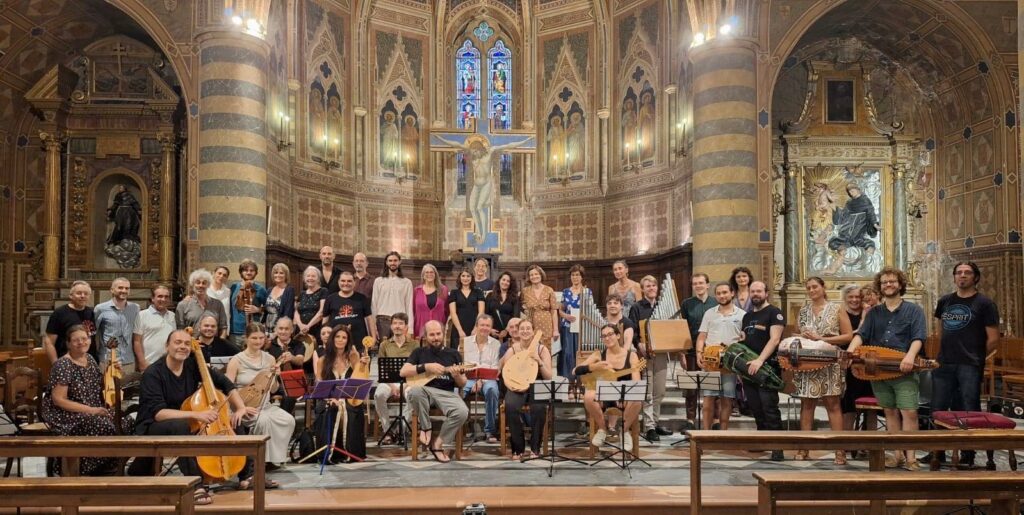
August 1st: FINAL CONCERT by the students

Traditional sacred dances of the Mediterranean countrie

Placida Staro, known as ‘Dina’ has been working on the relationship between sound, voice, gesture and culture, on the self-research of local cultures and on symbolic and choreutic-musical expression since she was a little girl. Through field research in ethnography, documentation in archives in Italy and abroad, methodological and epistemological research on the analysis of movement and the techniques of bodily processing of self-discovery in song, music and dance, she has developed original terminologies and epistemological approaches and new methodologies in the field of training and education that are internationally recognised. Her artistic activity as a stage director, choreographer, violinist, actress and singer, which began in 1974, is still ongoing. She is currently President of the Ethnochoreology Study Group of the International Council for Traditions of Music and Dance, Director of the Centre for Research and Documentation of Montanara Culture in Monghidoro, directs two publishing series and in 2023 received the ‘Loano Award for Traditional Music’ for her career.

Masterclasses, Lessons and Workshops of Medieval singing, lute, wind instruments, percussions
Conferences and lectures on aspects of Medieval music.

in Spello (Italy) from July 28th  to 2th of  August 2025  

Cantico 

From the Laudes Creaturarum of San Francesco to the repertoire of the fifteenth century laudist

Music courses

To discover ancient music instrumentis such as Archs, Lute, Medieval Picks, Wind Instruments, Hurdy Gurdy, Medieval Percussions and Dulcimer

Concerts and events

Medieval Music concerts to discover some specific music instruments such as Zampogne, Shawn and Bagpipe.

News

News and updates related to our musical events, institutional activities and much more ...

Course of medieval music
Singing, Lute, Bowed instruments, Wind Instruments, Hardy Gurdy, Portative organ,Percussions, Traditional dances courses
from July 28th to August 2nd 2025
In Spello (Perugia)

Lectures in Spello at 7:00 pm (free)

28 -07-2025  Placida Staro:Salve, Regina!

29-07-2025  (online) Lucia Marchi: Sulla ricostruzione musicale delle Laudes Creaturarum di Francesco d’Assisi

30-07-2025  Crawford Young: “La Cetra di Francesco”

31-07-2025 Marco Gozzi:  Dal segno del Laudario di Cortona al suono vivo

01-08-2025 (online) Francesco Zimei : La lauda specchio dell’evoluzione formale nella musica italiana del medioevo e rinascimento

Student Concerts
Final Essay of the
Course of Medieval Music
Saturday 2nd august 2025, 6:30 pm
Church of Sant’Andrea

Power and beauty of our musical traditions

With the Spello Splendens Festival and the International Medieval Music Course we want to rediscover a precious musical tradition made up of strings, lutes, medieval wind instruments, ghigonda and much more …

Medieval music courses

Stay up to date on our events, concerts and music courses!

Do you want to discover the precious musical tradition of the Middle Ages made up of strings, lutes, wind instruments, songs and much more?